|
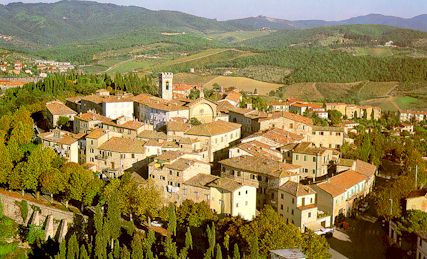
| Radda, now known as Radda in Chianti, is a Tuscan wine village located between the valleys of the rivers Pesa and Arbia in Italy, on a forested hillside surrounded by extensive vineyards. A small number of shops and restaurants in Radda in Chianti provide a supply centre for the wineries of the territory. The surrounding hills are dotted with castles, some in ruins, some still inhabited. There are numerous excellent agriturismi within easy reach of Radda, providing vacation accommodation for tourists at highly competitive prices. There is no better way to enjoy the ambience of Tuscany, Italy, than to stay in a Bed and Breakfast, farmhouse apartment or villa on a working Tuscany vineyard. Radda has limited bus service - a car is recommended. |
|
|
|
|
|
|
| The municipal territory of
Radda in Chianti
covers 80.5 square km on the hills around the
deep valleys of the rivers Pesa and Arbia. It was a feudal centre and then
the residence of a mediaeval podesta from the 13 C onwards. It
was confirmed in its present day boundaries with the Leopoldine reforms of 1774. Radda was recorded for the first time with certainty in an edict of the Emperor Otto III from 1003 when its Court and castle were owned by the Florentine Abbey to whom they had been donated by the Marquis di Toscana, to whom it was confirmed by the Imperial authority. This was repeated several times in the following decade either by an act of succession by Otto or by a series of Papal endorsements. Radda became a feudal possession of the Guidi Counts in 1220, by command Federico II. Towards the middle of the 13 C (the precise date is not known), Florence affirmed its dominion here because of Radda's strategic importance. From 1176, Florence had jurisdiction over the greater part of southern Chianti previously belonging to Sienna. Firenze put Radda at the head of one of the three "Thirds" in which the Chianti League was administratively divided, and starting from 1384 at the latest, it became capital of the Chianti League, as is shown by the oldest preserved statutes. In the middle of the 1300s, on the orders of the Florentine government, the wall of the castle were reinforced, and new fortifications were needed after the Aragonese invasion in 1478 during which the Radda castle was conquered and devastated. Other periods of warfare had to be lived through in the first half of the 1500s, until the fall of the Siennese republic. From then on Radda was principally an active agricultural centre. |
|
||||||
|
|
|
Pubblicizza qui la tua attivitą e vedi ora i risultati! Vorresti pubblicizzare la tua attivitą su questo sito web per la Radda in Chianti e ricevere traffico in entrata dalla nostra rete di pił di 50 portali relativi? Clicca qui per ulteriori dettagli in merito alla nostra soluzione integrata per una presenza su internet piena di successi. |
|
For
your country accommodations in Chianti - stay in the cool Chianti hills -
B&B rooms, apartments with pool. |